National Council Of Women Meets Permanent Parliamentary On Gender Equality And Women Empowerment
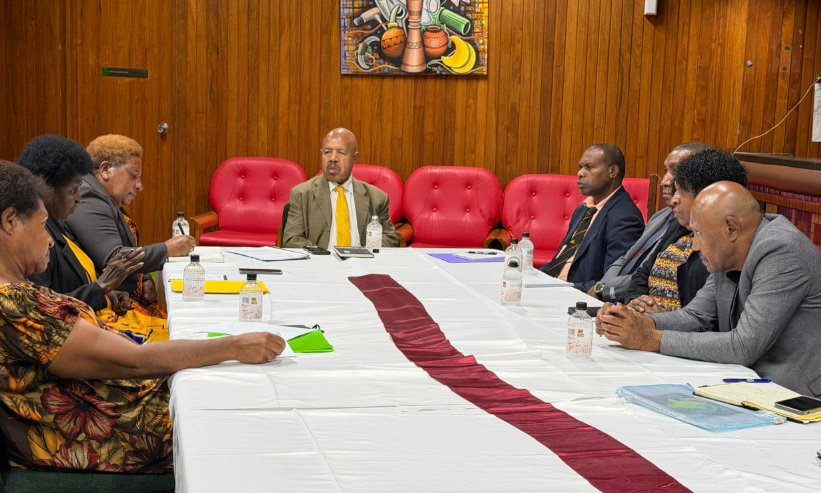
The National Council of Women , held a high-level meeting with the Chairman of the Permanent Parliamentary Committee on Gender Equality and Women’s Empowerment, Hon. Powes Parkop, and the Minister for Community Development and Religion, Hon. Jason Peter, Secretary for Community Development Mr. Jerry Ubase together with senior officials from the Department of Community Development and Religion and the Office for the Development of Women.
The meeting, held at the State Function Room at Parliament House, provided a platform for open dialogue on the challenges facing the NCW and marked an important step toward restoring coordination, trust, and effective partnership between government and the country’s peak women’s organisation.
Governor Parkop, in his role as Chairman of the Permanent Parliamentary Committee on GEWE stressed that the National Council of Women must be recognised and strengthened as a strategic national institution in Papua New Guinea’s long-term efforts to promote gender equality and advance women’s empowerment.
“We cannot build a safe, inclusive and progressive nation if women and girls are left behind,” Governor Parkop said. “The National Council of Women must be part of the solution — not an afterthought. It is critical to our Vision 50 agenda and to the future of this country.”
He announced a K1.5 million commitment from the National Capital District Commission to support the revival of the NCD Council of Women, including office accommodation and basic operational capacity, as a starting point to mobilise women more effectively at the city level.
Minister Jason Peter acknowledged the concerns raised by NCW leaders and reaffirmed his Ministry’s commitment to resolving administrative issues and strengthening collaboration.
“This meeting allows us to hear directly from the elected leadership of the NCW and to identify a clear way forward,” the Minister said. “The social sector carries heavy national responsibilities, and we must work together to overcome the constraints we face.”
NCW President Sabeth Yengis welcomed the meeting, describing it as a long-overdue opportunity to address uncertainty and rebuild the Council after years of dormancy.
“The National Council of Women is not a private organisation — it belongs to the women of Papua New Guinea,” she said. “We want to leave a strong legacy, restore confidence, and ensure that women’s voices are heard and respected.”
Vice President Dicu Gairi highlighted the difficulties experienced by the elected executive since the national convention, including the absence of office space, limited funding, and breakdowns in communication.
“This is not about individuals,” she said. “It is about putting in place a solid foundation so that future women leaders do not face the same challenges.”
Interim General Secretary Barbara Toiya reminded participants that the NCW is established by an Act of Parliament and must be treated with the respect accorded to national institutions.
“We cannot speak meaningfully about gender equality and women’s empowerment if the very institution that represents women is undermined or silenced,” she said.
Responding on behalf of the Department of Community Development and Religion, Secretary Jerry Ubase acknowledged that many of the issues raised were administrative in nature and offered an apology for past miscommunication. He confirmed that arrangements would be made to secure office accommodation for the NCW and reaffirmed that the Council reports directly to the Minister.
“These matters can be resolved,” Mr Ubase said. “We are committed to improving coordination and supporting the work of the National Council of Women.”
The meeting concluded with a shared commitment to improved communication, clearer administrative processes, and stronger political advocacy to secure increased and more sustainable support for women’s institutions. Participants also noted the importance of positioning the NCW to play an active role in upcoming national initiatives, including PNG’s 50th Anniversary programs and planned GEWE and GBV policy actions.
The engagement marked an important reset in the relationship between government and the National Council of Women, with all parties expressing a common goal: to ensure that women and girls are central to Papua New Guinea’s development and future.